
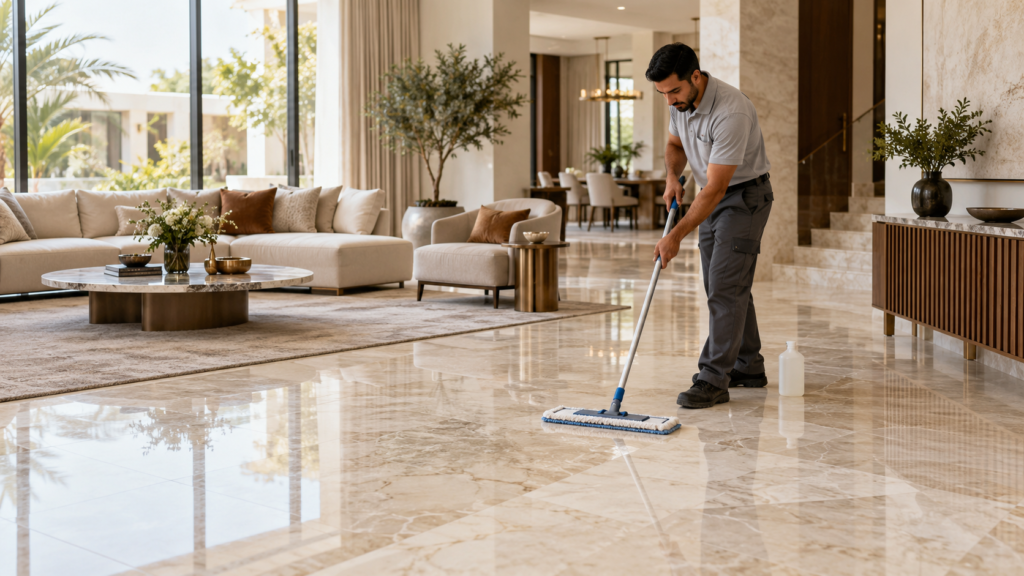
Proper marble maintenance in UAE homes helps natural-stone floors, countertops and walls retain their elegant appearance. Marble is durable, but it is also sensitive to acidic liquids, abrasive dirt and unsuitable cleaning chemicals. Daily habits therefore have a major effect on its long-term condition.
Dust and fine sand can enter homes through doors, shoes and open spaces. When these particles remain on a polished marble floor, regular foot traffic may gradually create fine scratches. Kitchens and bathrooms face additional risks from oils, coloured liquids, moisture and personal-care products.
This guide provides nine practical tips for cleaning and protecting marble in villas and apartments across the UAE.
Why Does Marble Need Special Maintenance?
Marble is a calcium-based natural stone. Its composition means it can react with acidic substances, including vinegar, lemon juice and certain bathroom or multipurpose cleaners.
This reaction may produce etching: a dull or lighter mark where the polished surface has been affected. Etching is different from staining, which occurs when a substance penetrates the stone and changes its colour.
Effective marble maintenance in UAE properties focuses on preventing scratches, removing spills quickly and using products formulated for natural stone.
1. Remove Dust and Sand Regularly
Fine dust and sand can act like an abrasive when walked across a marble floor. Regular dry cleaning is one of the simplest ways to protect polished surfaces.
Use:
- A clean microfibre dust mop
- A soft-bristled vacuum attachment
- A vacuum with wheels suitable for hard flooring
- Clean entrance mats inside and outside doors
Avoid stiff brushes and damaged vacuum heads that may scratch the stone.
In busy entrances and corridors, dry cleaning may be required more frequently than in bedrooms or low-traffic rooms.
2. Use a pH-Neutral Stone Cleaner
Use a cleaning product labelled as pH-neutral and suitable for natural marble. Follow the manufacturer’s dilution and application instructions.
Avoid using:
- Vinegar
- Lemon-based cleaners
- Acidic bathroom cleaners
- Limescale removers
- Strong alkaline degreasers
- Abrasive cleaning powders
- Bleach mixtures
- Metal scouring pads
Do not assume that a product is safe simply because it is marketed as natural or multipurpose. Always confirm that it is compatible with marble.
Choosing the right cleaner is a fundamental part of marble maintenance in UAE homes and commercial spaces.
3. Clean Spills Immediately
The longer a liquid remains on marble, the greater the possibility of staining or etching.
Pay special attention to:
- Coffee and tea
- Fruit juices
- Soft drinks
- Cooking oils
- Sauces
- Cosmetics
- Perfumes
- Coloured cleaning products
- Lemon and vinegar
Blot the spill with a soft absorbent cloth instead of spreading it across the surface. Clean the area with an appropriate stone cleaner and dry it with a clean microfibre cloth.
If a mark remains, identify whether it is a stain or etch before selecting a treatment.
4. Use Minimal Water and Dry the Surface
Excessive water is not necessary for routine marble cleaning. Use a damp—not soaking wet—microfibre mop and change dirty cleaning water regularly.
After cleaning, dry the surface to reduce streaks and water marks. Pay attention to joints, corners and areas around skirting.
In bathrooms, improve ventilation and remove standing water from vanity tops and shower areas. Good drying habits form an important part of marble maintenance in UAE bathrooms, where surfaces may be exposed to frequent moisture.
5. Protect High-Traffic Areas
Entrance halls, corridors and frequently used living spaces are more likely to collect sand and experience wear.
Protect these areas by using:
- Non-slip entrance mats
- Rugs with marble-safe backing
- Protective pads under furniture
- Floor protectors beneath chairs
- Shoe-removal areas near entrances
Check rug backings before use. Some rubber or coloured materials may transfer marks or trap moisture against the stone.
Clean underneath rugs periodically so dust does not accumulate and scratch the floor.
6. Prevent Kitchen Countertop Damage
Marble kitchen countertops require additional care because they are exposed to acidic foods, oils and hot cookware.
Use:
- Chopping boards during food preparation
- Trays under cooking oils and sauces
- Coasters beneath drinks
- Trivets beneath hot pans
- Mats under small appliances
- Soap trays around sink areas
Do not cut directly on the marble. Knives can scratch the surface, and food acids may cause etching.
For further guidance, read our complete article about marble kitchen countertops in UAE.
Consistent daily protection makes marble maintenance in UAE kitchens easier and reduces the need for corrective treatments.
7. Test Whether the Marble Needs Sealing
A penetrating sealer can help reduce the absorption of liquids, but it does not make marble completely stain-proof or acid-proof.
Sealing requirements vary according to:
- Marble type
- Surface finish
- Existing treatment
- Location
- Usage
- Cleaning routine
- Product used during installation
Do not follow a universal resealing schedule without assessing the surface. Ask a stone-care professional to inspect the marble and recommend a suitable product and interval.
Before applying any treatment, test it on a small, inconspicuous area. Incorrect sealers or excessive application can create uneven colour, residue or a cloudy appearance.
8. Do Not Confuse Stains with Etching
Stains and etching require different treatments.
What Is a Stain?
A stain usually appears when a liquid or oil penetrates the marble and changes its colour. The treatment depends on the type and depth of the substance.
What Is Etching?
Etching affects the finish after the marble reacts with an acidic substance. It may appear as a dull, pale or rough area, particularly on polished stone.
Applying a stain remover will not necessarily repair etching. Polished surfaces may require professional honing and repolishing.
Correct identification is essential for safe marble maintenance in UAE properties. If the cause is unclear, avoid experimenting with multiple chemicals and request professional advice.
9. Arrange Professional Polishing When Necessary
Daily cleaning cannot repair deep scratches, widespread etching, uneven shine or damaged joints. These conditions may require professional restoration.
Depending on the marble’s condition, the work may include:
- Deep cleaning
- Stain assessment
- Grinding
- Honing
- Polishing
- Joint repair
- Crack evaluation
- Sealing
Grinding is not required for every floor. Minor loss of shine may need a less intensive treatment, while significant lippage or deep damage requires a more detailed assessment.
A qualified technician should inspect the stone before recommending a restoration process.
Daily Marble Cleaning Routine
A simple routine can prevent many common problems:
- Remove loose dust with a clean microfibre mop.
- Clean spills as soon as they occur.
- Use a diluted pH-neutral stone cleaner when wet cleaning is required.
- Work in manageable sections.
- Replace dirty water and cloths regularly.
- Dry the surface with a clean microfibre cloth.
- Check entrances and high-traffic areas for accumulated sand.
This routine is suitable for general marble maintenance in UAE homes, but cleaning frequency should reflect the room’s usage and exposure to dirt.
Weekly and Monthly Checks
In addition to daily cleaning, inspect marble surfaces regularly.
Look for:
- Dull patches
- New scratches
- Darkened joints
- Loose sealant around sinks
- Water accumulation
- Stains beneath bottles
- Worn entrance areas
- Damaged rug backing
- Movement around countertop joints
Early attention can prevent a small issue from developing into a larger repair.
How to Care for Polished Marble
Polished marble reflects light and displays the stone’s colour and veins clearly. It can also reveal scratches, etching and uneven wear more easily.
Use soft cleaning tools and avoid abrasive materials. In large rooms, maintain a consistent cleaning method across the entire floor to prevent uneven shine.
Polished floors may become slippery when wet, so remove water promptly and use suitable mats near entrances and wet areas.
How to Care for Honed Marble
Honed marble has a matte or satin finish. Etching may be less visually prominent than on polished stone, but stains can still occur.
The surface still needs compatible cleaning products and appropriate sealing. Avoid applying wax or products designed to create artificial shine unless they are specifically approved by the stone-care professional managing the surface.
Marble Care in Bathrooms
Bathrooms expose marble to water, soap, cosmetics and personal-care products.
To protect bathroom marble:
- Wipe vanity surfaces regularly
- Keep perfume and cosmetic bottles on trays
- Dry standing water
- Ventilate the room
- Clean soap residue using a marble-safe product
- Inspect silicone and joints around wet areas
- Avoid acidic limescale removers
If hard-water deposits appear, consult a stone-care professional before using a strong remover. Many conventional descaling products are acidic and can damage marble.
Marble Care for Villa Flooring
Large villa floors require consistent maintenance across entrances, corridors, stairs and living areas.
The best marble for villa flooring in Dubai should still be supported by suitable entrance mats, routine dust removal and periodic professional assessment.
Furniture should be lifted rather than dragged. Place protective pads beneath table legs, chairs and decorative items, and replace worn pads when necessary.
Common Marble Cleaning Mistakes
Avoid these common mistakes:
- Cleaning marble with vinegar
- Leaving spills until later
- Using an excessively wet mop
- Applying random stain-removal chemicals
- Scrubbing with abrasive pads
- Dragging furniture across the floor
- Mixing cleaning products
- Applying sealer without preparing the surface
- Polishing over dirt or residue
Safe marble maintenance in UAE homes relies on correct products and consistent habits rather than aggressive cleaning.
When Should You Contact a Professional?
Request professional assistance if you notice:
- Deep scratches
- Cracks or movement
- Widespread etching
- Persistent stains
- Uneven floor levels
- Loose tiles
- Damaged joints
- Cloudy sealer
- Significant loss of shine
Take clear photographs and explain which cleaning products were previously used. This information can help the technician assess the likely cause.
Protecting Your Marble for the Long Term
Marble develops character with use, and minor variations are normal for a natural material. The objective of maintenance is not to make marble look artificial, but to protect it from avoidable damage.
Regular dust removal, prompt spill cleaning and appropriate products provide the foundation for effective marble maintenance in UAE properties.
For additional care information, consult the Natural Stone Institute’s stone care guidance.
Request Marble Maintenance Assistance
Ahlami Alraeeah provides natural-stone solutions for villas, kitchens, bathrooms and customised interior projects across Dubai and the UAE.
Our team can assist with marble assessment, maintenance recommendations and project-specific stone requirements. Contact Ahlami Alraeeah to discuss the condition of your marble surfaces.