
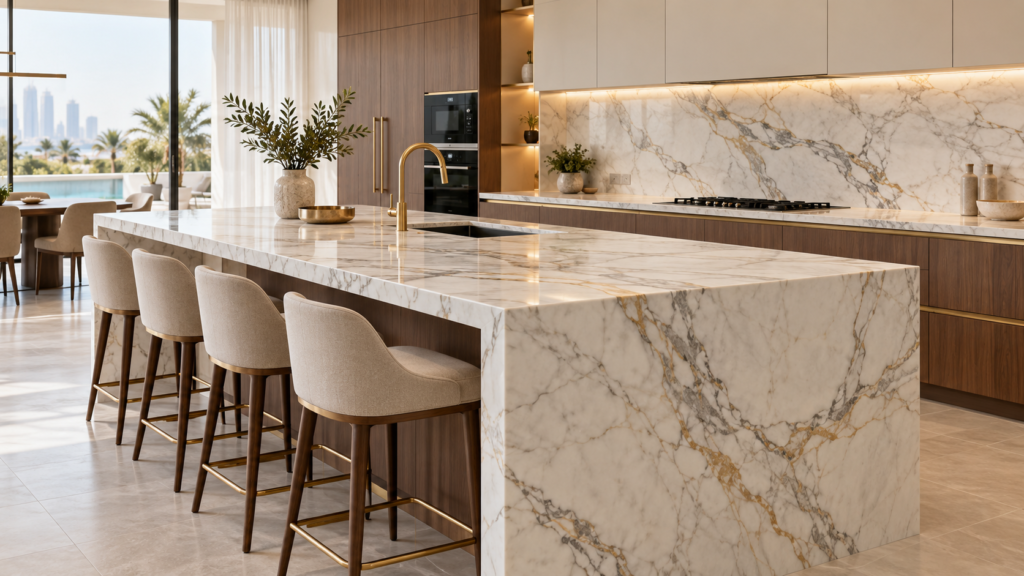
Choosing marble kitchen countertops in UAE homes can create an elegant, distinctive and timeless kitchen. Natural marble offers unique veining and sophisticated colours that cannot be perfectly duplicated by manufactured surfaces. However, choosing marble for a kitchen requires careful consideration because countertops are exposed to heat, moisture, oils, food preparation and daily cleaning.
The right marble, finish and sealing system can provide an impressive surface for villas, apartments and luxury residential projects. Before selecting a slab, homeowners should understand how marble performs, which types are suitable and what maintenance it requires.
This complete guide explains the key factors to consider before purchasing marble kitchen countertops in UAE, including material selection, finishes, durability, installation and long-term care.
Why Choose Marble for Kitchen Countertops?
Marble has a refined appearance that works with contemporary, classic and transitional kitchen designs. Every slab is formed naturally, giving it individual veins, colours and patterns.
Well-selected marble kitchen countertops in UAE homes can complement cabinetry, improve the overall interior design and create a distinctive focal point.
The main benefits of marble countertops include:
- A luxurious and timeless appearance
- Unique natural patterns in every slab
- Availability in white, beige, grey, brown and darker colours
- Compatibility with wood, metal and painted cabinetry
- A naturally cool surface suitable for pastry preparation
- Multiple edge profiles and customised fabrication options
- The ability to create matching islands, backsplashes and wall cladding
Marble can become the visual centre of a kitchen, particularly when the same slab pattern continues across a large island or full-height backsplash.
1. Select the Right Type of Marble
Not every marble slab has the same colour, hardness, porosity or pattern. Selecting the right material is one of the most important decisions when planning marble kitchen countertops in UAE properties.
Carrara Marble
Carrara marble typically has a white or light-grey background with subtle grey veins. Its restrained appearance makes it suitable for modern and minimalist kitchens.
It coordinates well with white, grey, navy and natural-wood cabinetry. The softer pattern can also make the countertop easier to integrate into an existing interior design.
Calacatta Marble
Calacatta marble is recognised for its bright background and bold grey or gold veining. It creates a stronger visual statement than Carrara and is frequently used in premium kitchens.
Because its veins are expressive, slab selection and layout are particularly important. A carefully positioned Calacatta slab can create a striking kitchen island or waterfall edge.
Statuario Marble
Statuario combines a light background with distinctive grey veins. It suits sophisticated interiors where the stone is intended to become a prominent design feature.
For the best visual result, the fabricator should plan every cut before production. This ensures that the most attractive sections remain visible and that the veins align across adjoining surfaces.
Crema Marfil Marble
Crema Marfil has a warm beige tone with delicate natural veins. It complements traditional kitchens, cream cabinetry, wooden finishes and warm metallic details.
Its neutral appearance makes it suitable for homeowners who want natural stone without the strong contrast associated with white and grey marble.
Emperador Marble
Emperador marble is available in rich brown tones with lighter veins. It creates a dramatic and luxurious appearance, especially when combined with beige cabinetry, timber and warm lighting.
Darker polished surfaces can show fingerprints, dust and water marks more clearly, so the finish and cleaning routine should be considered before selection.
2. Inspect the Complete Marble Slab
A small sample cannot show the complete movement, vein distribution and colour variation of natural marble. Always inspect full slabs before confirming your purchase.
When reviewing a slab, check:
- Background colour and consistency
- Vein direction and intensity
- Natural fissures or filled sections
- Surface finish
- Available dimensions
- Slab thickness
- Compatibility between multiple slabs
If the kitchen requires more than one slab, select pieces from the same batch where possible. Place them next to each other to check whether the colours and veins coordinate properly.
The selected sections should then be allocated to the island, countertop, backsplash and waterfall edges before cutting begins.
3. Choose Between Polished and Honed Finishes
The finish affects the appearance, texture and maintenance of marble kitchen countertops in UAE homes.
Polished Marble
A polished finish has a glossy and reflective surface. It enhances the colour and veins of the stone and creates a formal, luxurious appearance.
Polished marble may show etching, fingerprints and surface marks more visibly. Acidic substances can dull parts of the finish if spills are not cleaned promptly.
Honed Marble
Honed marble has a smooth, matte or satin surface with minimal reflection. It creates a softer and more contemporary look.
Minor etching may be less noticeable on a honed surface, but the material still needs appropriate sealing and care. The ideal finish depends on the selected marble, kitchen design and maintenance expectations.
4. Understand Staining and Etching
Marble is a natural calcium-based stone. It can react with acidic ingredients such as lemon juice, vinegar and some cleaning products.
Two common issues should be understood:
Staining
Staining happens when liquids or oils enter the stone and change its colour. Proper sealing helps reduce absorption, but it does not make marble completely stain-proof.
Coffee, cooking oil, sauces and coloured liquids should be removed quickly. Using trays under oil bottles and coasters beneath drinks can provide additional protection.
Etching
Etching is a surface reaction that can leave a dull mark when marble comes into contact with acidic substances. It is different from a stain and may require professional refinishing.
Homeowners who prefer a perfectly uniform surface may find these natural changes challenging. Others accept gradual patina as part of the character of genuine marble.
5. Select a Suitable Countertop Thickness
Marble countertops are commonly fabricated in different thicknesses depending on the material, edge design and project requirements.
A thicker visual profile can be created either with a solid slab or a built-up edge. The correct choice depends on:
- Slab availability
- Cabinet structure
- Countertop span
- Sink and appliance openings
- Desired edge profile
- Overall design style
The cabinetry must be level and capable of supporting the stone. Large islands, extended breakfast counters and unsupported sections may require additional reinforcement.
The fabricator should confirm all structural requirements before cutting the marble.
6. Plan the Edge Profile and Vein Direction
The edge profile influences the overall character of the kitchen. Simple straight or eased edges suit contemporary interiors, while bevelled and decorative profiles complement traditional designs.
Common options include:
- Straight edge
- Eased edge
- Bevelled edge
- Bullnose edge
- Mitred edge
- Waterfall edge
Vein direction is equally important. On an island with a waterfall edge, the pattern should appear to continue naturally from the horizontal surface down the side panel.
Professional planning helps marble kitchen countertops in UAE kitchens look consistent across joints, corners and visible edges.
7. Work with an Experienced Marble Fabricator
Accurate measurement and fabrication are essential for natural-stone countertops. Mistakes made during cutting may be difficult or impossible to correct.
An experienced fabricator should:
- Produce an accurate site template
- Confirm sink and appliance measurements
- Review the position of taps and accessories
- Plan all joints and edge profiles
- Arrange veins before cutting
- Use appropriate CNC or waterjet equipment when required
- Transport the pieces safely
- Install and level the countertops correctly
- Apply suitable sealing after installation
Before fabrication begins, all cabinets should be installed, secured and level. The final sink, hob and built-in appliances should also be available or supported by accurate manufacturer templates.
Marble or Granite for a Kitchen Countertop?
Both materials are natural stones, but they perform and look different.
Marble is often chosen for its elegant veins, bright appearance and premium character. Granite is generally selected for its durability and resistance to everyday kitchen use.
The better option depends on the homeowner’s priorities. Marble may be ideal when design and natural veining are the main focus and the owner is comfortable with regular care. Granite may suit busy kitchens where lower maintenance is preferred.
For a broader comparison, read our guide: Marble vs Granite: Which Is Better for Your UAE Home?
Can Marble Be Used Around a Kitchen Sink?
Marble can be installed around a kitchen sink when it is properly fabricated, supported and sealed.
Water should not remain around the sink edges for extended periods. The installation team must seal the sink opening and joints correctly to help prevent water penetration.
Undermount sinks can create a clean appearance, but accurate cutting and polished internal edges are required. The position of taps, water filters and soap dispensers should be confirmed before fabrication.
Can Hot Pans Be Placed on Marble?
Natural stone can tolerate warmth, but placing very hot cookware directly on a marble countertop is not recommended.
Sudden temperature changes may affect the surface, sealant or surrounding joints. Always use a heat-resistant trivet beneath hot pots, pans and baking trays.
This simple habit protects both the marble and the long-term finish of the countertop.
Properly fabricated marble kitchen countertops in UAE properties can provide lasting visual appeal when supported by suitable sealing and daily care.
How to Maintain Marble Kitchen Countertops
Correct daily care helps marble kitchen countertops in UAE properties maintain their appearance.
Use these practical maintenance steps:
- Clean spills immediately
- Use a soft cloth or non-abrasive sponge
- Choose a pH-neutral natural-stone cleaner
- Avoid vinegar, lemon and acidic cleaning products
- Do not use abrasive powders or harsh brushes
- Use chopping boards during food preparation
- Place trays under oils and frequently used bottles
- Use trivets under hot cookware
- Arrange resealing when the surface requires it
Sealing frequency depends on the marble, sealant, usage and cleaning routine. Instead of following a fixed schedule, ask a stone professional to inspect the surface and recommend resealing when needed.
Additional maintenance information is available through the Natural Stone Institute’s stone care guidance.
How Much Do Marble Kitchen Countertops Cost in the UAE?
The cost varies according to the marble type, origin, slab grade, dimensions and project complexity. Premium white marble with rare or consistent veining generally costs more than widely available beige or grey varieties.
The final quotation may include:
- Marble slabs
- Site measurement and templating
- Material cutting and polishing
- Sink and hob openings
- Edge fabrication
- Backsplash pieces
- Waterfall side panels
- Transportation and lifting
- Installation materials
- Sealing and final finishing
Compare quotations based on the complete scope, not only the price per square metre. A cheaper quotation may exclude important fabrication or installation items.
Are Marble Countertops Right for Your Kitchen?
Marble is an excellent choice for homeowners who value natural beauty and accept that genuine stone requires appropriate care. It works especially well in kitchens where visual character, customised fabrication and premium finishes are priorities.
Before ordering marble kitchen countertops in UAE, inspect the complete slabs, discuss how the kitchen will be used and confirm all fabrication details. A suitable stone combined with professional installation can create an elegant and functional kitchen surface.
Request a Marble Countertop Consultation
Ahlami Alraeeah provides marble and natural-stone solutions for kitchens, villas and customised interior projects in Dubai and across the UAE.
Our team can assist with slab selection, measurement, precision cutting, edge fabrication and installation planning. Contact Ahlami Alraeeah to discuss marble kitchen countertops for your project.