
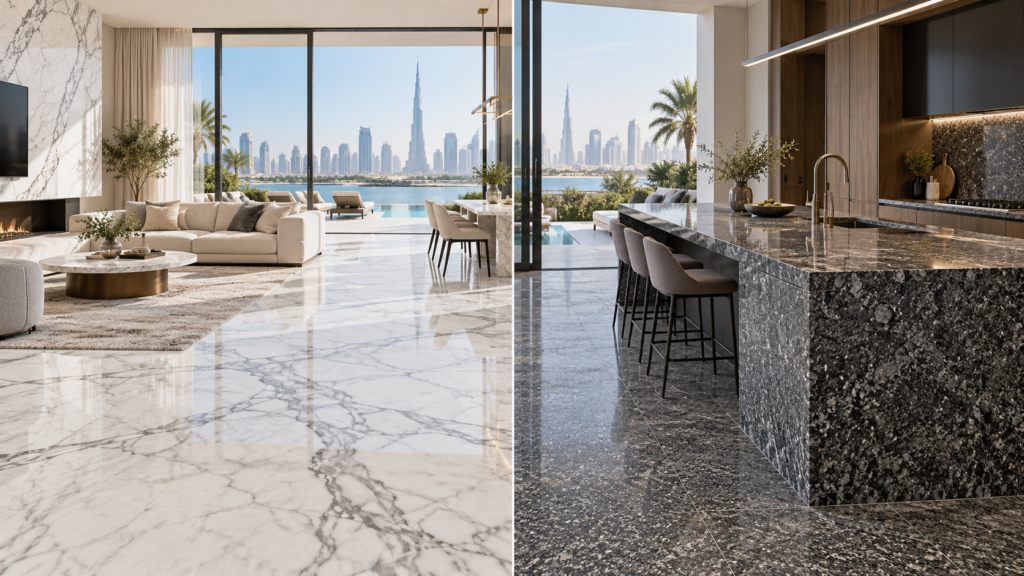
Choosing between marble and granite is an important decision when selecting natural stone for your home. Both materials offer durability, beauty and long-term value, but they perform differently depending on where and how they are installed. When comparing marble vs granite for a UAE home, you should consider appearance, durability, heat resistance, maintenance, cost and the location of the installation.
This guide explains the key differences between the two materials and helps you choose the right natural stone for flooring, kitchen countertops, bathrooms, staircases, wall cladding and outdoor areas.
Marble vs Granite: Quick Comparison
The marble vs granite comparison is not simply about choosing which stone looks better. Each material has different characteristics that make it more suitable for certain applications.
Marble is known for elegant flowing veins, softer colour transitions and a luxurious appearance. It is widely used for premium flooring, feature walls, bathrooms, staircases and decorative surfaces.
Granite usually has a granular or speckled pattern. It is harder, highly durable and commonly selected for busy kitchens, outdoor spaces, high-traffic flooring and commercial applications.
The best choice depends on the visual result you want, the amount of daily use the surface will receive and the level of maintenance you are comfortable with.
What Is Marble?
Marble is a natural stone formed when limestone is exposed to intense heat and pressure beneath the earth’s surface. This geological process creates its elegant veins, smooth texture and distinctive natural patterns.
Every marble slab is unique. The colour, movement and vein distribution vary from one slab to another, which makes marble especially attractive for customised architectural and interior design projects.
Marble is commonly used for:
- Interior flooring
- Feature walls
- Staircases
- Bathroom walls and floors
- Vanity tops
- Reception areas
- Decorative panels
- Fireplace surrounds
- Table tops
- Luxury kitchen surfaces
Marble is available in white, beige, grey, brown, green, black and many other colours. The final appearance depends on the stone variety, country of origin, slab selection and surface finish.
What Is Granite?
Granite is a dense natural stone formed from slowly cooled magma beneath the earth’s surface. It contains minerals such as quartz and feldspar, which give it a strong structure and recognisable grain-like texture.
Granite is generally harder and more resistant to scratches than marble. This makes it a practical material for surfaces exposed to frequent use, heat, dust or outdoor conditions.
Granite is commonly used for:
- Kitchen countertops
- Outdoor flooring
- Building façades
- High-traffic floors
- Staircases
- Bathroom counters
- Commercial interiors
- Outdoor kitchens
- Work surfaces
- Landscaping features
It is available in black, white, grey, red, blue, green, brown and other natural shades.
1. Marble vs Granite: Appearance and Style
Appearance is one of the most noticeable differences between these materials.
Marble usually features flowing veins and softer colour transitions. It creates an elegant and luxurious appearance that works particularly well in villas, hotel entrances, reception areas and premium residential interiors.
Granite normally has a granular or speckled pattern. Some granite varieties are visually consistent, while exotic stones may include dramatic colours and movement.
The marble vs granite decision often begins with the design style you want to create.
Choose marble when you want:
- Elegant natural veining
- A luxurious interior finish
- A softer and more artistic appearance
- A distinctive feature wall or staircase
- A bright and spacious atmosphere
Choose granite when you want:
- A strong and practical appearance
- A more consistent surface pattern
- Bold natural colours
- A surface suitable for frequent use
- A material that works indoors and outdoors
2. Marble vs Granite: Durability
Granite is generally harder and more resistant to scratches, chips and daily wear. It is often selected for busy kitchens, commercial areas, outdoor flooring and other frequently used spaces.
Marble is also durable, but it requires more careful use. Its surface may be affected by acidic substances, abrasive cleaners and heavy impacts.
With professional installation, suitable sealing and regular maintenance, marble can remain beautiful for many years. The installer must also choose the correct adhesive, fixing method and surface finish for the application.
For high-traffic areas or frequently used work surfaces, granite is usually the more practical option. For spaces where visual elegance is the main priority, marble can provide a more luxurious result.
3. Marble vs Granite for Kitchen Countertops
Granite is often preferred for busy kitchen countertops because it offers strong resistance to scratching and heat. A correctly installed and maintained granite surface is also relatively easy to clean.
Marble can still be used for kitchen countertops, especially when the design requires an elegant, bright or premium finish. However, homeowners should understand that marble requires additional care.
Acidic liquids such as lemon juice, vinegar and some cleaning products may affect marble. Spills should be cleaned quickly, and cutting boards and heat-resistant pads should always be used.
For a busy family kitchen requiring easier maintenance, granite is usually the safer option. For a statement kitchen where natural beauty is the priority, professionally fabricated and sealed marble can be an excellent choice.
4. Marble vs Granite for Flooring
Both materials can be used for flooring, but the correct selection depends on the location, expected foot traffic and required finish.
Marble flooring is popular in UAE villas, luxury apartments, reception areas and entrances because it creates a bright, spacious and sophisticated atmosphere. Its natural veins make every floor installation unique.
Granite flooring is well suited to entrances, corridors, commercial properties and outdoor areas where increased resistance is required.
For luxury interior flooring, marble is often preferred. For high-traffic or outdoor flooring, granite usually offers greater practicality.
The surface finish is also important. Polished stone provides a glossy appearance, while honed, brushed or textured finishes may offer better suitability for entrances, wet areas and outdoor locations.
5. Marble vs Granite for Bathrooms
Marble is widely used in bathrooms because it can create a seamless luxury design across the floor, walls, shower area and vanity top.
Because bathrooms are regularly exposed to water and cleaning products, marble should be properly installed and maintained. A suitable surface finish should also be chosen to help reduce slipping in wet areas.
Granite works well for bathroom vanity tops and surfaces requiring additional resistance. It is durable, practical and available in a wide selection of colours.
The final choice depends on whether the priority is a spa-like luxury appearance or easier daily maintenance.
6. Marble vs Granite in the UAE Climate
The UAE climate includes high temperatures, strong sunlight, dust and humidity in some areas. The installation location therefore plays an important role when selecting natural stone.
Granite is generally a strong choice for outdoor applications because of its density and durability. Suitable granite varieties can be used for external flooring, façades, outdoor steps, kitchens and landscaping.
Some marble varieties can also be installed outdoors, but not every type is suitable for prolonged sun exposure or external conditions.
When comparing marble vs granite for exterior use, the exact stone variety and surface finish must be considered. The fixing method, adhesive, joint spacing, drainage and sealing system can be just as important as the selected stone.
Professional advice is recommended before ordering stone for any outdoor project.
7. Marble vs Granite: Maintenance and Care
Marble should be cleaned using a soft cloth or mop and a pH-neutral stone cleaner. Acidic or abrasive cleaning products should be avoided.
Depending on the marble variety and installation location, periodic sealing may be recommended. Spills should be cleaned promptly, particularly on kitchen counters, vanity tops and dining surfaces.
Granite is generally easier to maintain. Regular cleaning with a mild, stone-safe product is often sufficient. Some granite surfaces may still benefit from sealing, depending on their absorption level, finish and application.
For additional professional guidance, review the Natural Stone Institute’s care and cleaning recommendations for natural stone.
Never assume that every stone requires the same treatment. Maintenance should be based on the specific material, finish and installation conditions.
Cost of Marble vs Granite in the UAE
The price of both materials can vary significantly. The country of origin, rarity, colour, slab size, thickness, finish and required fabrication all affect the final cost.
Standard varieties may be cost-effective, while rare natural stones with distinctive colours and patterns can cost considerably more.
A complete project quotation should include:
- Material selection
- Required slab quantity
- Cutting and fabrication
- Edge finishing
- CNC or waterjet work
- Transportation
- Surface preparation
- Installation
- Polishing
- Sealing where required
Choosing stone based only on the price per square metre may result in an inaccurate budget. The total cost should reflect the complete scope of supply, fabrication, delivery and installation.
How to Choose the Right Natural Stone
Before deciding between marble vs granite, consider the following questions:
- Will the stone be installed indoors or outdoors?
- Is the area exposed to heavy foot traffic?
- Will the surface come into contact with food, liquids or heat?
- How much maintenance are you comfortable with?
- Do you prefer flowing veins or a granular pattern?
- Is your priority luxury, durability or a balance of both?
- Does the stone complement the lighting and colours of the space?
- Will the project require custom cutting or special edge details?
- Does the selected stone suit the technical requirements of the application?
- Is professional installation included in the project scope?
Viewing the full slab before fabrication is highly recommended. A small sample cannot always represent the movement, colour variation and vein distribution of the complete slab.
The slab layout should also be planned before cutting, especially when the project requires vein matching, bookmatching or multiple connected surfaces.
Final Verdict: Marble vs Granite
There is no single winner in the marble vs granite comparison. The best material depends on the application, design requirements and expected level of use.
Marble is an excellent choice for elegant interiors, luxury flooring, feature walls, bathrooms, staircases and decorative architectural elements.
Granite is often better for busy kitchens, high-traffic areas, outdoor spaces and surfaces requiring additional resistance.
In many UAE properties, the best solution is to use both materials strategically. Marble can provide visual luxury in key interior spaces, while granite delivers additional practicality in kitchens and exterior areas.
Ahlami Alraeeah Marble supplies a wide selection of marble, granite, onyx, quartzite and other natural stones for residential and commercial projects in Dubai and across the UAE.
Our services include stone selection, custom fabrication, CNC and waterjet cutting, supply, installation, polishing and finishing.
Explore our marble and natural stone collection or contact our team for professional assistance selecting the right material for your project.